
Research
My research is situated in international relations, with a focus on international political economy and international organizations. I study globalization – and the backlash against globalization –, international (non-)cooperation, and financial crises. My research has made contributions on the distributional conflict between the winners and losers of different aspects of the globalization of finance, production, and labor and to understanding how voters, governments and international dynamics interact to create or mitigate a backlash against globalization. Current projects examine the backlash against globalization, perceptions of the changing world order, and the contestation of global governance. I am currently particularly interested in responses to non-cooperation in international relations.
I strive to publish high-quality research on substantively important topics that straddles different sub-disciplines, especially international relations, political economy, and political behavior. Often, my research puts singular events into a larger, theoretically informed context and to analyze these events in a theory-driven manner. My research agenda therefore prioritizes questions that are important and pressing from a policy viewpoint, but examines them in a theoretically informed and empirically sophisticated manner aimed at generating generalizable insights into wider phenomena.
COMPLETED PROJECTS

The Mass Politics of Disintegration (DISINTEGRATION)
2019-2025
www.disintegration.ch
DISINTEGRATION was a research project run by Stefanie Walter (University of Zurich) and funded by an ERC Consolidator Grant. It examined the mass politics of disintegration and paid particular attention how other voters, elites and governments in other countries respond to voter-endorsed challenges to international institutions. DISINTEGRATION conducted a broad, systematic, and comparative inquiry into the mass politics of disintegration with a particular focus on reactions in the remaining member states.
DISINTEGRATION explored three main research questions:
1) PUBLIC OPINION. When and how does one country’s mass-based disintegration experience encourage or deter demands for disintegration in other countries?
2) DOMESTIC DISCOURSE. How are the contagion effects of mass-based disintegration transmitted through domestic elites and domestic discourse?
3) DISINTEGRATION NEGOTIATIONS. How do the remaining member states respond to one member state’s mass-based disintegration bid?
See here for a project summary.
PROJECT RESULTS
DISINTEGRATION has made major conceptual, empirical, and methodological contributions to the study of how unilateral, voter-endorsed disintegration bids reshape the political dynamics of
international cooperation. The project delivered on its core objective: to uncover how such bids affect public attitudes, elite discourse, and international negotiations—not only in the initiating
country but also across borders. The project has generated a rich body of evidence and theoretical insight that moves the field significantly forward. Below are the central achievements in each work
package
WP1 on PUBLIC OPINION has advanced our understanding of the public opinion dynamics surrounding disintegration with an unprecedented combination of longitudinal and comparative data. The project successfully completed six waves of a cross-national tracking survey and a six-wave Swiss panel survey, creating one of the most extensive public opinion datasets on disintegration to date. These surveys revealed that Brexit reverberated well beyond the UK, reshaping perceptions of EU membership across the continent and influencing domestic debates in Switzerland. The findings challenge conventional wisdom by showing that disintegration does not automatically empower Eurosceptic forces—instead, public reactions depend on expectations, perceived costs, and the observed consequences of exit. Through these results, WP1 contributes decisively to the comparative study of international cooperation in the eyes of citizens. Six publications came from this work package, include Grynberg et al (2020), Walter (2021b), Malet (2022), Malet and Walter (2023a, 2023b), Malet and Thibeaut (2024).
WP2 on ELITE DISCOURSE has produced novel insights into elite-level dynamics by combining large-scale textual analysis with qualitative political research. The team constructed a high-resolution corpus of nearly one million media articles from over a dozen European countries, as well as substantial corpora of elite political communication. This enabled the identification of transnational contagion effects in elite discourse, especially among nationalist parties. One of the key findings is that far from emboldening calls for exit elsewhere, the Brexit experience prompted nationalist actors to soften their rhetoric and adjust their demands—highlighting the constraining power of disintegration outcomes on elite strategies. The shift in WP2a toward parliamentary discourse also yielded important contributions. Three publications came from this work package (Martini and Walter 2024, Hunter 2024, Hunter and Walter 2025)
WP3 on DISINTEGRATION NEGOTIATIONS has pushed forward the comparative analysis of disintegration negotiations by capturing the strategic dilemmas faced by international institutions when responding to unilateral withdrawals. Analyses of the EU27’s approach to Brexit show how the Union navigated competing imperatives: protecting the integrity of the single market while avoiding a punitive stance that might escalate domestic tensions within the UK. (Jurado, Léon and Walter 2021) This work challenges simplistic accounts of EU unity or fragmentation and instead highlights the complexity and nuance of coordinated international responses. Beyond Brexit, WP3 produced a comparative dataset on all disintegration referendums since 1945, offering one of the first systematic analyses of institutional responses to voter-endorsed withdrawal efforts (Walter and Plotke-Scherky 2025). These insights have sharpened our understanding of the negotiation logics that shape institutional resilience and adaptation in times of crisis. Two publications came from this work package (Jurado, Léon and Walter 2021, Walter and Plotke-Scherky 2025)
WP4 on THEORY-BUILDING has delivered integrative theoretical advances that synthesize the findings from across the empirical work packages. Rather than treating disintegration as an isolated phenomenon, the project positions it within a broader framework of backlash against globalization, mass-based international contestation, and the legitimacy challenges facing international institutions. Theoretical contributions include new models of how public, elite, and institutional responses interact over time, as well as normative reflections on the democratic and sovereignty-related implications of popular disintegration bids. Two publications came from this work package (de Vries, Hobolt, and Walter 2021, Walter 2021a).
In sum, DISINTEGRATION has produced a body of work that is theoretically innovative, empirically robust, and highly relevant to current debates in both academia and policy. Its achievements include the development of new conceptual tools (e.g. “voter-endorsed disintegration”), the assembly of unique datasets capturing public and elite dynamics over time and across borders, and the publication of findings that illuminate the transnational ripple effects of disintegration processes. As the project concludes, its data infrastructure, theoretical models, and empirical insights are already informing academic research and public discourse. The project’s outputs—including six major datasets, published replication materials, and a growing number of scholarly publications—will provide lasting value to researchers and practitioners seeking to understand and respond to the destabilizing pressures on international cooperation
This project has received funding from the University of Zurich and the European Research Council (ERC) under the European Union’s Horizon 2020 research and innovation programme grant agreement No 817582 (ERC Consolidator Grant DISINTEGRATION).
Inequality, group identities and political demands
Project with Tarik ABou-Chadi, Silja Häusermann and Tabea Palmtag, funded by the UZH URPP Equality of Opportunity
Structural inequalities between social classes, men and women, as well as ethnic minority and majority groups do not translate directly into politically relevant and salient conflictive divides. Hence, we need to understand the processes of politicization of inequality, in order to establish a link between inequalities and democratically sustainable policies supposed to address them. Therefore, this sub-project studies how increasing economic inequalities translate into the political sphere in three regards: (i) how structural economic inequalities and political narratives drive changing perceptions of inequalities, as well as changing political group identities among voters; (ii) how these group identities shape political demands in terms of social policy, taxation and education policy; and (iii) how group identities and policy demands affect the electoral sphere in terms of voting behavior.
Globalization and Individual Policy and Partisan Preferences
This project investigates how individuals’ exposure to global competition influences their feeling of economic security and a wide range of policy preferences, and how the emergence of new conflict lines between beneficiaries and losers of globalization changes the constituencies of political parties.I argue that globalization has very heterogenous effects, which depend both on individuals' exposure to global competition and their factor-endowments. This suggests that even within the same industry, exposure to global competition can be harmful to some people, but not to others. In developed countries, high-skilled individuals in exposed industries or occupations can be characterized as “globalization winners,” because they can sell their skills to global markets. In contrast, low-skilled individuals working in an exposed sector face serious problems. The goods they produce are most likely to be substituted with imports from low-wage countries and their jobs are the most likely to be moved abroad, so that they can be classified as “globalization losers.” Individuals working in sheltered industries or occupations constitute an intermediate category. I use individual-level data to test the implications of these differentiated effects of globalization.
Output and Work in Progress:
- Ahlquist, John, Mark Copelovitch, and Stefanie Walter (2020). The Political Consequences of International Financial Shocks: Evidence from Poland. American Political Science Review
- Rommel, Tobias and Stefanie Walter (2017). The Electoral Consequences of Offshoring. How the Globalization of Production Shapes Party Preferences in Multi-Party Systems. Comparative Political Studies. 51(5): 621– 658.
- Walter, Stefanie (2017). "Globalization and the Demand-Side of Politics. How globalization shapes labor market risk perceptions and policy preferences." Political Science Research and Methods 5(1): 55-80.
- Walter, Stefanie (2016). Mitten durch die Gesellschaft. DeFacto Expert Blog Entry, 4 April 2016.
- Dancygier, Rafaela and Stefanie Walter (2015). 'Globalization, Labor Market Risks, and Class Cleavages'. In: Beramendi, Pablo, Silja Häusermann, Hebert Kitschelt and Hanspeter Kriese (eds). The Politics of Advanced Capitalism. Cambridge: Cambridge University Press. 133-56.
- Walter, Stefanie (2010). Globalization and the Welfare State. Testing the Microfoundations of the Compensation Hypothesis. International Studies Quarterly. 54(2): 403-26. Link
Micro-Level Consequences of Financial Crises
This project examines how individuals respond to financial crises. It includes studies on the effect of foreign currency lending on individual political opinions in Eastern Europe, survey-research in Greece, and individual-level studies on public opinion during the 2008-10 Latvian financial and economic crisis. In a collaborative effort with colleagues from the University of York, Oxford University and IE University, we have run several surveys of public opinion on crisis management and the euro in Greece (July 2015, September 2015, December 2015, and February 2017).
Output and Work in Progress:
- Ignacio Jurado, Stefanie Walter, Nikitas Konstantinidis, and Elias Dinas (2020). Keeping the Euro at any cost? Explaining preferences for euro membership in Greece. European Union Politics
- Dinas, Elias, Nikitas Konstantinidis, Ignacio Jurado, and Stefanie Walter (2015). "Tsipras reaps benefits of brinkmanship politics." Peripheral Vision Blog
- Walter, Stefanie. 2015. "What were the Greeks Thinking? Here's a Poll Taken just before the Referendum." The Monkey Cage Blog.
- Jurado, Ignacio, Nikitas Konstantinidis, and Stefanie Walter. 2015. "Why Greeks voted the way they did in the bailout referendum." LSE European Politics and Policy Blog: LSE.
Distributional Conflicts and the Politics of Adjustment in the Eurozone Crisis
Project funded by the Swiss National Science Foundation
The euro crisis has turned into the most serious challenge the European Union has ever had to face. Although the causes of the crisis are increasingly well
understood, the politics of the crisis are not. This project aims at shedding light on three important puzzles that existing research has not yet been able to resolve. First, why have some
governments been able to implement far-reaching reforms, whereas reform progress has been rather spotty in other crisis countries? Second, why have some countries seen serious political turmoil,
while others have experienced less public and political opposition? And finally, why have surplus countries been willing to bail out deficit countries, but have varied in their willingness to adjust
their own economic policies in an effort the ease the adjustment burden on the South?
The project argues that these differences can be explained by the variation in societies’ vulnerabilities to different types of policy responses to the crisis. The argument builds on the insight that
the euro crisis is, at its root, a balance-of-payments crisis. The imbalances that underlie such crises can be resolved either through significant economic policy adjustments both in the (peripheral)
deficit or the (northern) surplus countries, or be addressed by providing external financing to deficit countries. I argue that the resulting distributive struggles surrounding the politics of the
euro crisis in surplus and deficit countries are distinct but related, and should therefore be analyzed in a unified framework. The chances for swift and substantial adjustment are enhanced when
politically influential interest groups exhibit a low vulnerability to at least one type of adjustment. In contrast, in contexts where significant parts of society are vulnerable to any adjustment,
crisis politics is very contentious. Surplus countries with such a vulnerability profile attempt to push most of the adjustment burden onto deficit countries. In return, they are willing to provide
external financing to deficit countries, but this generates conflict about on who should bear this financial burden. Since deficit countries are in a weaker position to push adjustment costs onto
surplus countries, the distributional conflicts there revolve around how the cost of adjustment is to be distributed among different societal groups.
Empirically, the project examines how vulnerability profiles affect domestic crisis politics and policies on two levels of analysis, the interest-group and the national level. It uses a mixed-methods
research design that combines two sets of qualitative comparative case studies of the domestic politics of the euro crisis in surplus and deficit countries, respectively, with a quantitative analysis
of national vulnerability profiles and crisis politics in a wider set of countries. The overarching goal of the project is to generate an encompassing picture of the distributional politics of the
euro crisis and a better understanding of the constraints under which European policymakers operate in their attempts to solve the crisis.
More information can be found here.
Output and Work in Progress:
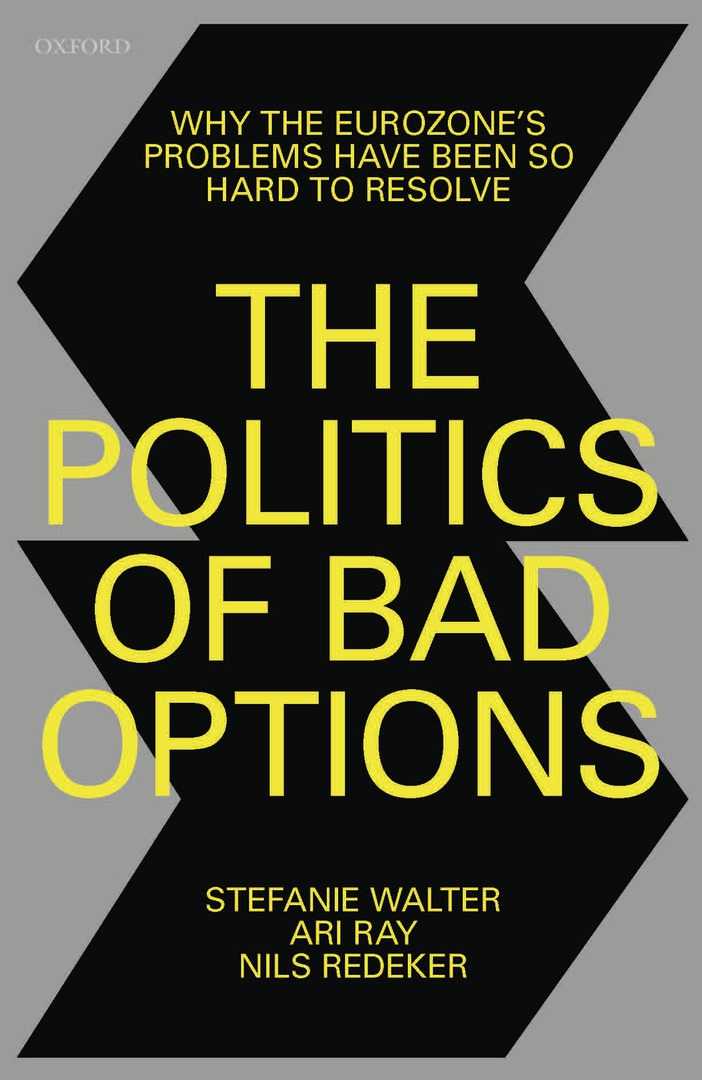
- Stefanie Walter, Ari Ray, and Nils Redeker (2020). The Politics of Bad Options. Why the Problems of the Eurozone have been so Difficult to Resolve. Oxford University Press.
- Frieden, Jeffry and Stefanie Walter (2019). Analyzing Inter-State Negotiations in the Eurozone Crisis and
Beyond. European Union Politics 20(1): 134-51
Nils Redeker and Stefanie Walter (2020). We'd rather pay than change. The politics of German non-adjustment in the Eurocrisis. Review of International Organizations - Jeffry Frieden, and Stefanie Walter (2017). Understanding the Political Economy of the Eurozone Crisis. Annual Review of Political Science 20
- Copelovitch, Mark, Jeffry Frieden, and Stefanie Walter (2016). The Political Economy of the Euro Crisis (Special Issue). Comparative Political Studies 49(7): 811-40.
- Copelovitch, Mark, Jeffry Frieden, and Stefanie Walter (2016). Was man über die Eurokrise wissen muss. DeFacto.expert blog, 14 June 2016.
- Copelovitch, Mark, Jeffry Frieden, and Stefanie Walter (2016). The euro zone is in crisis. Here are the four most important lessons to take away. The Monkey Cage Blog.
Crisis Management and Crisis Politics in the Global Financial Crisis and the Euro Crisis
This project analyzes policy responses, crisis politics, and distributive outcomes of national crisis management towards the global financial crisis and the euro crisis.
Output and Work in Progress:
- Walter, Stefanie (2016). Crisis politics in Europe: Why austerity is easier to implement in some countries than in others. Comparative Political Studies 49(7): 841-7
- Walter, Stefanie (2016). Here's why it's so hard to pull Greece out of its economic crisis. The Monkey Cage Blog, 20 April 2016.
- Walter, Stefanie (2015). "Austerität oder Abwertung. Warum Staaten unterschiedlich auf Zahlungsbilanzkrisen reagieren." Politische Vierteljahresschrift 2015 (2).
- Walter, Stefanie (2013). 'Verteilungskonflikte in der Eurokrise und die politische Handlungsfähigkeit von Demokratien.' In: Hubertus Buchstein (ed.) Die Versprechen der Demokratie, Baden-Baden: Nomos: 77-88
The Politics of Delayed Adjustment and Crisis
Why are some policymakers able to adjust their policies in response to deteriorating economic conditions, while other policymakers delay adjustment as long as possible, a policy path that typically ends with an economic crisis? This project examines this question by focusing on the area of exchange-rate policy, where delayed devaluations frequently end with a currency crisis. The project extends my research on exchange-rate politics and analyses how exchange-rate level preferences interact with institutions to shape monetary and exchange-rate policy outcomes. I am particularly interested in explaining time-inconsistencies in exchange-rate policymaking. The project examines how distributional and electoral concerns can create strong incentives for policymakers to delay adjustment as long as possible. I argue that these incentives are particularly strong when voters are very vulnerable to both exchange and interest rate adjustments. Major currency crashes are particularly likely when voters are highly exposed to exchange rate changes but even more vulnerable to internal adjustment policies, and when electoral incentives prevent timely reform.
This project was generously funded by the Fritz-Thyssen Foundation.
Output and Work in Progress:
- Walter, Stefanie (2013): Financial Crises and the Politics of Macroeconomic Adjustment. Cambridge: Cambridge University Press.
- Walter, Stefanie (2011). The Fiscal Policy Implications of Balance of Payments Imbalances. In: Anheier, Helmut and Regina List (eds.) Governance Challenges and Innovations: Financial and Fiscal Governance. Oxford: Oxford University Press: 89-114.
- Walter, Stefanie (2009). Interests and Incentives to Delay Adjustment: Why Policymakers Fail to Address Early Signs of Trouble and How They Respond to Crises. Paper presented at the 2009 APSA Annual Convention in Toronto, Canada, 3-6 September 2009.
- Walter, Stefanie and Thomas D. Willett (2012). Delaying the Inevitable. A Political Economy Approach to Currency Defenses and Depreciation. Review of International Political Economy. 19(1): 114-39.
Micro-Level Consequences of the 2008/9 Financial Crisis in Germany
This project examined how the 2008/9 global financial and economic crisis affected the outcome of the German federal elections 2009. Based on insights from research on economic voting, it investigates three main issues. First, it examines how the geographically diverse impact on of the crisis on local labor markets and the regional economy affected individual voting behavior and voting outcomes at the constituency level. Second, it investigates how subjective economic evaluation affected individual electoral behavior. A third part of the project examines how voters assessed the government's anti-crisis policies, such as public guarantees for banks and the so-called Abwrackprämie, and studies whether and how these assessments affected vote intentions. The project employs a mix of quantitative data (survey data and electoral records) and qualitative data from semi-structured interviews.
Output and Work in Progress:
- Philipp Trein, Ruth Beckmann, and Stefanie Walter (2017). "German voters in times of crisis: The impact of perceptions and economic context on electoral behavior." German Politics
- Goerres, Achim and Stefanie Walter (2016). The Political Consequences of National Crisis Management. Micro-Level evidence from German Voters during the 2008/9 Global Economic Crisis. German Politics. 25(1): 131-53
- Beckmann, Ruth, Philipp Trein, and Stefanie Walter (2011). 'Dominanz der Ökonomie: Entscheidet die Wirtschaftslage Wahlen?' in: Evelyn Bytzek and Sigrid Roßteutscher (eds.) Der deutsche Wähler. Demaskierung einer Mythos. Frankfurt a.M.: Campus: 229-50.
Explaining Policy Responses to Speculative Attacks. The Political Economy of Currency Crises.
Dissertation Project, 2003-2007
My dissertation examined the question why some governments devalue their exchange rate in response to speculative pressure, while others are willing to defend their currency at any cost. Employing both quantitative and qualitative methods, I found that political and institutional factors (such as interest group preferences, regime type, or elections) play an important role in determining currency crisis outcomes.
Output and Work in Progress:
- Walter, Stefanie (2007). Explaining Policy Responses to Speculative Attacks.The Political Economy of Currency Crises. Dissertation. Zurich: ETH Zurich
CONTACT
Prof. Dr. Stefanie Walter
Institute for Political Science
University of Zurich
Affolternstr. 56
8050 Zurich
Switzerland
+41 44 634 5832
walter -at- ipz.uzh.ch
@stefwalter.bsky.social

NEWS
New publication: Walter, Stefanie and Nicole Plotke-Scherly (2025). Responding to unilateral challenges to international institutions. International Studies Quarterly. 69(2)
 Druckversion